Turning Court Recordings Into Reliable Legal Transcripts.
14 July, 2026· Article by Maria Jones


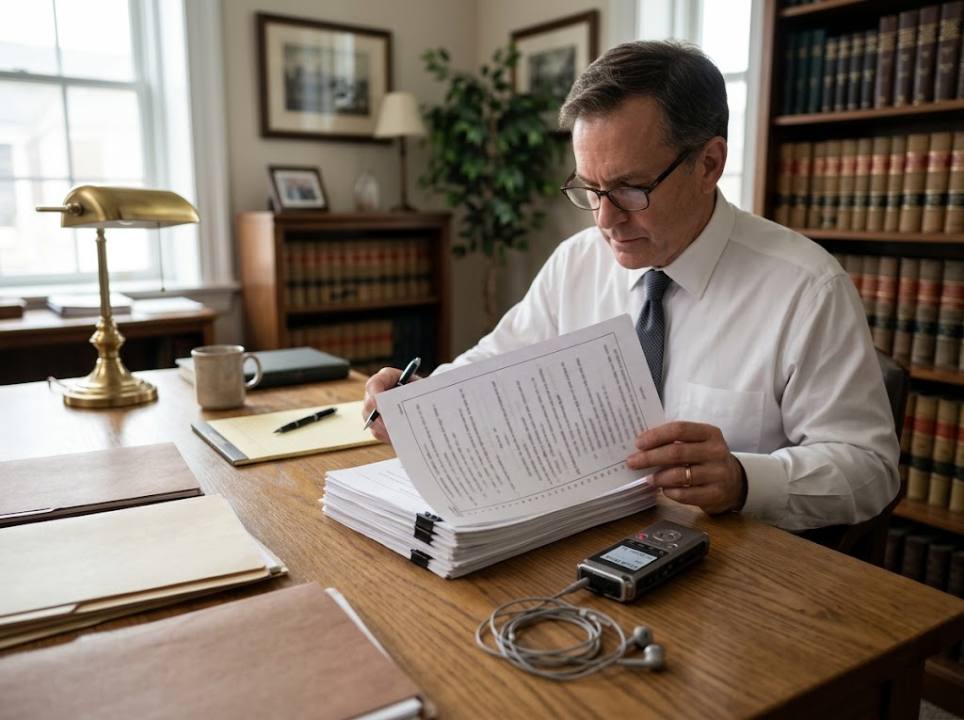
A two-hour hearing can produce a single sentence that decides an appeal. If that sentence is misheard, mistyped or mistranslated, the whole file becomes weaker. That is why law firms that handle international disputes treat transcription as evidence work, not admin work.
This article walks through how court and deposition recordings become reliable written records, and what changes when the parties speak different languages.
Why the Transcript Matters More Than the Recording
Judges, arbitrators and opposing counsel rarely listen to hours of audio. They read. The transcript is what gets quoted in submissions, highlighted in bundles and cited in judgments. A recording proves what was said, but the transcript is how people actually use it.
A transcript is only as useful as its weakest page. One wrong date, a swapped name or a missing "not" can shift the meaning of testimony and invite a challenge.
Clean Verbatim or Full Verbatim
Before work starts, the legal team should decide which style they need. Full verbatim keeps every hesitation, false start and filler word. Clean verbatim removes the noise while keeping the meaning untouched.
For cross-examination, full verbatim is usually safer, because pauses and corrections can reveal credibility issues. For a contract negotiation recording used as background, clean verbatim is faster to read and cheaper to produce.
Speaker labels and timestamps
Every speaker should be identified consistently, and timestamps should appear at regular intervals or at each change of speaker. This lets counsel jump straight to the right minute of audio when a passage is disputed.
When the Hearing Involves More Than One Language
International arbitration, family cases with foreign parties and commercial disputes often include testimony in two or three languages. A witness may answer in Romanian while counsel asks questions in English through an interpreter.
In these situations, the transcript has two jobs. It must capture the original words exactly, and it must offer a translation that the tribunal can rely on. Firms usually bring in legal translation services at this stage, because legal terminology does not travel neatly between systems. A "deposition" in the US, a "witness statement" in England and an "audition de témoin" in France are related ideas, but they are not identical procedures.
Specialist language support matters too. A romanian translator who knows legal vocabulary will catch nuances that a general linguist could miss, such as the difference between types of inheritance claims or property rights.
Certification and Admissibility
Many courts and authorities ask for translated transcripts to carry a signed statement of accuracy. In the UK this is often a declaration from the translator or agency, while other jurisdictions require a sworn or court-appointed linguist.
Working with a certified translator from the start avoids a painful second round of work. If the translation is produced informally and later rejected, the firm loses time just when deadlines are tight.
The professional rules for solicitors also put responsibility on the firm for the quality of evidence it relies on. The Solicitors Regulation Authority sets out standards of competence and integrity that apply to how evidence is prepared and presented.
A Practical Workflow for Legal Teams
Firms that handle recordings regularly tend to follow a simple, repeatable process:
- Intake. Collect the audio, the case reference, a list of names and any technical terms.
- First pass. A transcriptionist produces the draft with speaker labels and timestamps.
- Legal review. A second person checks names, dates, numbers and legal terms against the case file.
- Translation. Foreign-language passages are translated and marked clearly so readers know which text is original.
- Certification. The final file is signed off with the required declaration.
Sharing a glossary early is one of the cheapest ways to improve accuracy. Names of companies, places and people are the most common source of errors in legal transcripts.
Audio Quality Is Half the Battle
Poor recordings cost money. Overlapping speech, rustling papers and distant microphones force transcriptionists to mark passages as inaudible. In a legal context, every "[inaudible]" is a gap that someone may try to exploit.
Simple steps help a lot. Place microphones close to each speaker, ask participants not to talk over each other and record a short test before the session begins. For remote hearings, ask each participant to use a headset rather than a laptop microphone.
Confidentiality and Data Handling
Court recordings often contain health information, financial details or the identities of vulnerable witnesses. Any provider handling them should explain where files are stored, who can access them and how long they are kept.
Ask for a confidentiality agreement before sending the first file. A reputable provider will already have one ready and will not hesitate to sign.
What Good Looks Like
A strong legal transcript reads cleanly, matches the audio line by line and leaves no doubt about who said what. When translation is involved, it shows the original and the translated text side by side or clearly marked, with a certificate that the court will accept.
For law firms, this is not a luxury. It is part of building a case that can survive scrutiny, whether the hearing takes place in London, Bucharest or Paris.
Final Thoughts
Court recordings hold the raw truth of a hearing, but the transcript is what carries that truth into the next stage of the case. Investing in accurate transcription, careful translation and proper certification protects both the client and the firm's reputation.
Recent Posts

Voice Over Services For Audio ...

Traduzione Audio Per Video Azi...
Traduzione Italiano Arabo Per ...

Traducción Para Empresas Con ...
Traducción Jurada Para Trámi...

Gedolmetschte Interviews richt...
Share it.

We use cookies
We use cookies to give you the best online experience, remember your preferences, and understand how the site is used. You can accept all cookies, reject optional ones, or choose which categories to allow.
Privacy PolicyCookie preferences
Choose which cookies we can use. Necessary cookies stay on because the site cannot work without them.
For more details, read our Privacy Policy.